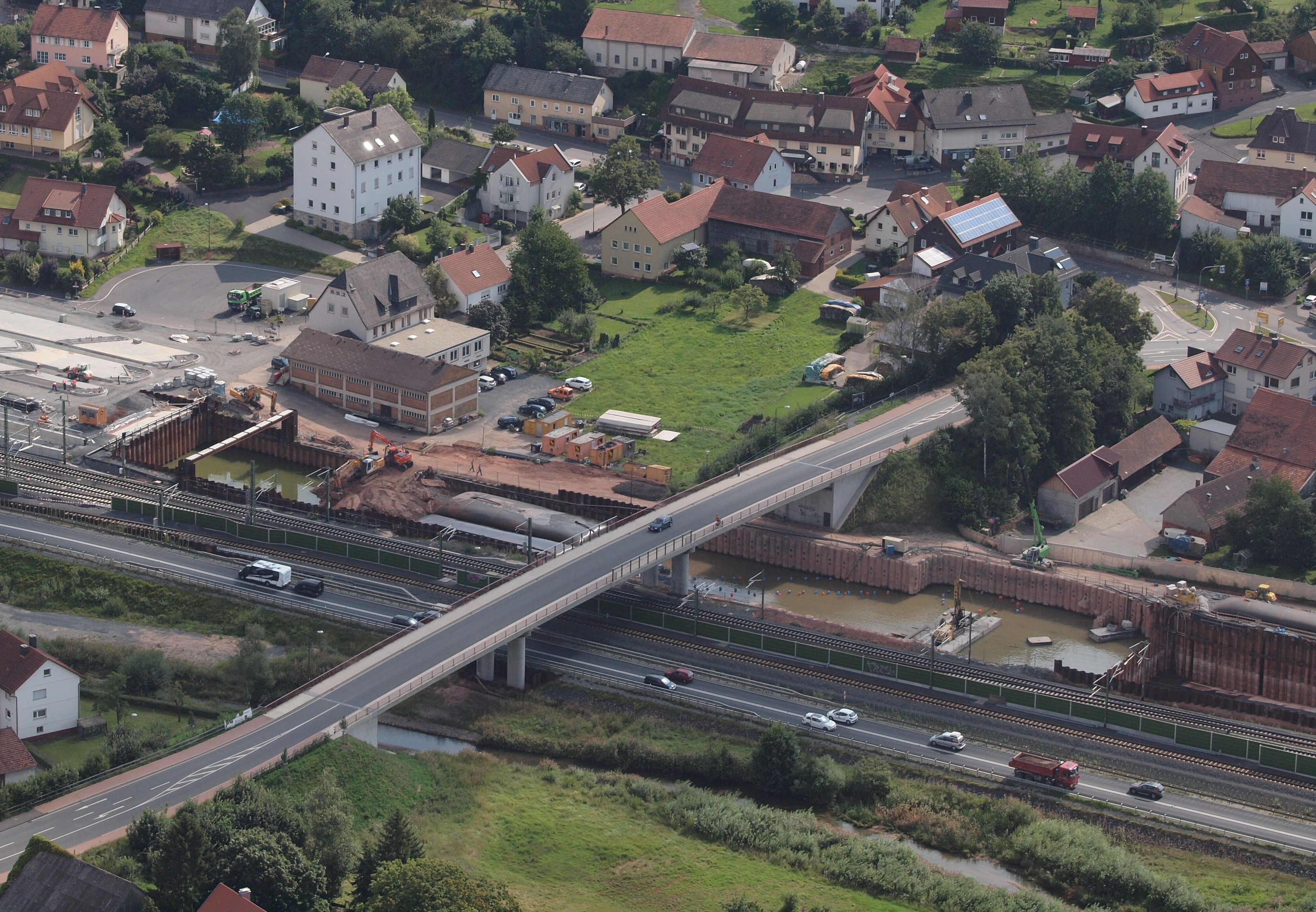


Desludging of an excavation pit floor
Project information
Construction project
Closing the gap on the A 66 motorway near NeuhofCustomer
Hessen Mobil FuldaConstruction
ARGE A66 Neuhof – Bickhardt Bau AG / Hermann & Kirchner Hoch- und Ingenieurbau GmbH / Hochtief Solutions AGLocation
Neuhof , DEConstruction time
March 2012 to November 2012Products used
Project details


Situation
In 2015, the 5 km-long gap closure on the A 66 between the Neuhof-Süd and Fulda-Süd junctions was completed. The centrepiece of this section was the 1.6 km long tunnel through Neuhof, which was constructed using the cut-and-cover method. This means that the tunnel tube was built in an excavation pit and then covered over again upon completion. Due to the high groundwater level in this particular area, the construction of this tunnel was highly demanding from an engineering perspective.
Solution
The extensive preparatory work required for underwater concreting also includes the removal of a layer of slurry approximately 1 m thick. Due to the confined space on the construction site and the tight schedule for the operation, a flushing solution was not feasible. The construction company therefore decided to dewater the extracted sludge directly next to the excavation pit using geotextile tubes. Initially, a special floating construction machine of the Watermaster type was used to extract the sludge; as the project progressed, divers took over this task. The extracted sludge was pumped to a dosing and mixing plant on land, where polymers were added in a controlled manner to bind the fine particles of the sludge into larger flocs. The treated sludge was finally pumped into SoilTain dewatering hoses, which were placed on a specially designed dewatering field.
The specially developed high-performance filter fabric allows for dewatering and the return flow of water into the excavation pit, whilst the solids are retained within the tubes. Filling takes place in several cycles until the SoilTain tube is finally filled with a solid mass that can be removed.
For the concreting work, the excavation pit was divided into three sections. Due to the confined conditions on site, the areas required for drainage were only available temporarily. To achieve optimal utilisation of the available space, a project-specific configuration with custom tube dimensions was required. Despite a tight schedule, SoilTain drainage tubes with dimensions specially adapted to the respective drainage fields were made available.
Advantages
Drainage using geotextile tubes originated in the field of environmental engineering, where sludge from reservoirs, water bodies or even sewage treatment plants is treated in this way. However, the A66 Neuhof project, as well as the previous de-sludging of an excavation pit in Hamburg-Harburg, demonstrate that the method of dewatering using geotextile tubes also offers a wide range of efficient applications in the field of specialised civil engineering.