


Geogrids enable bridge ramp construction
Project information
Construction project
Upgrading of State Road 2183Customer
Bayreuth State Building AuthorityConstruction
Scharnagl Hoch- und Tiefbauunternehmen; Centrum PfähleLocation
Bindlach , DEPlaning
EDR-IngenieurbüroConstruction time
August to October 2012Products used
Project details


Situation
The extension of State Road 2183 north of Bindlach requires the construction of a bridge structure to eliminate a level crossing. During the first construction phase, the bridge structure had already been founded on in-situ concrete piles. In the subsequent construction phase, the task was to connect the bridge approach to the existing structure without settlement. To this end, the Technical University (TU) of Munich was commissioned to determine a suitable foundation method, taking into account the structure’s location within a water protection area.
Solution
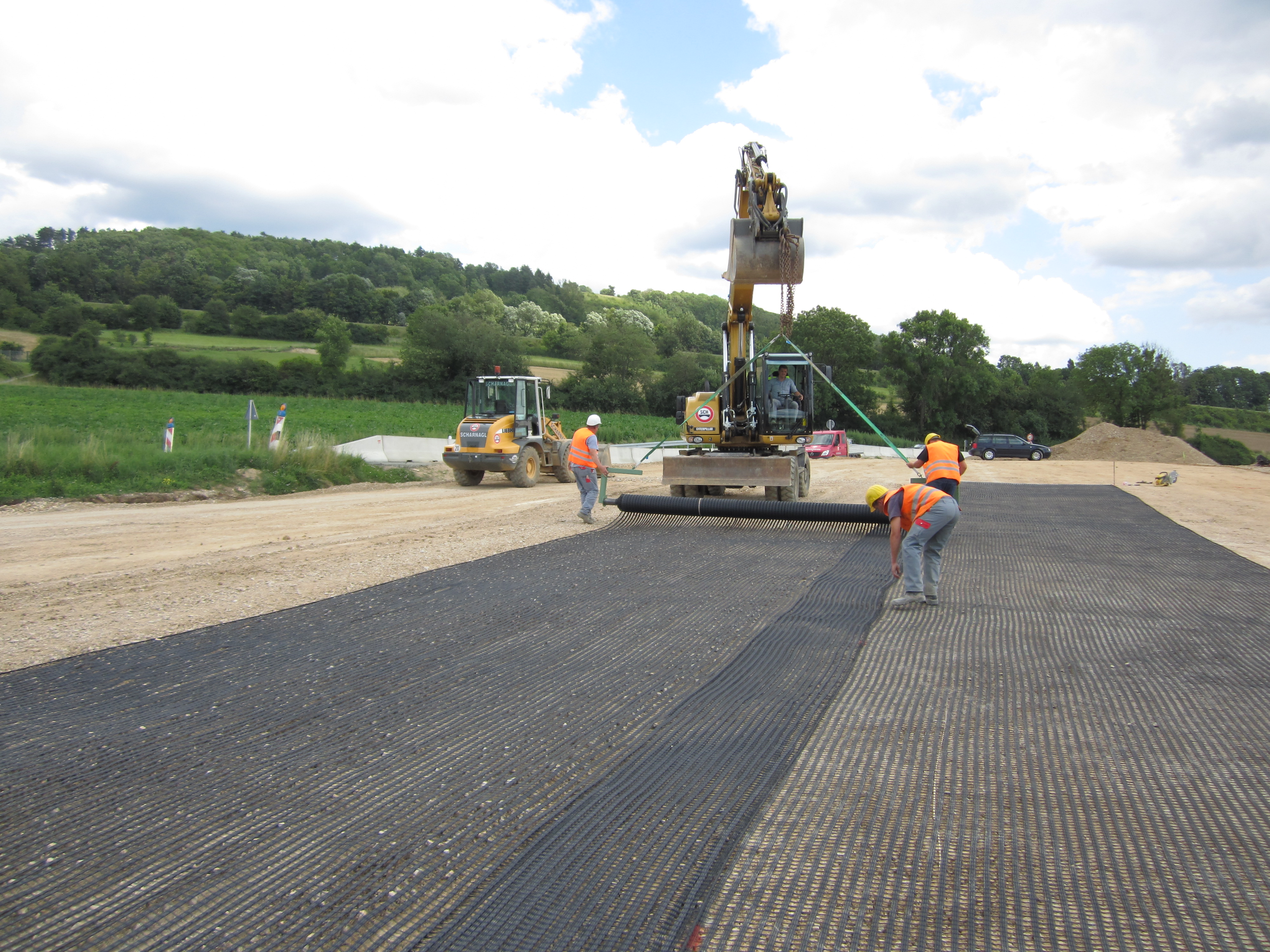
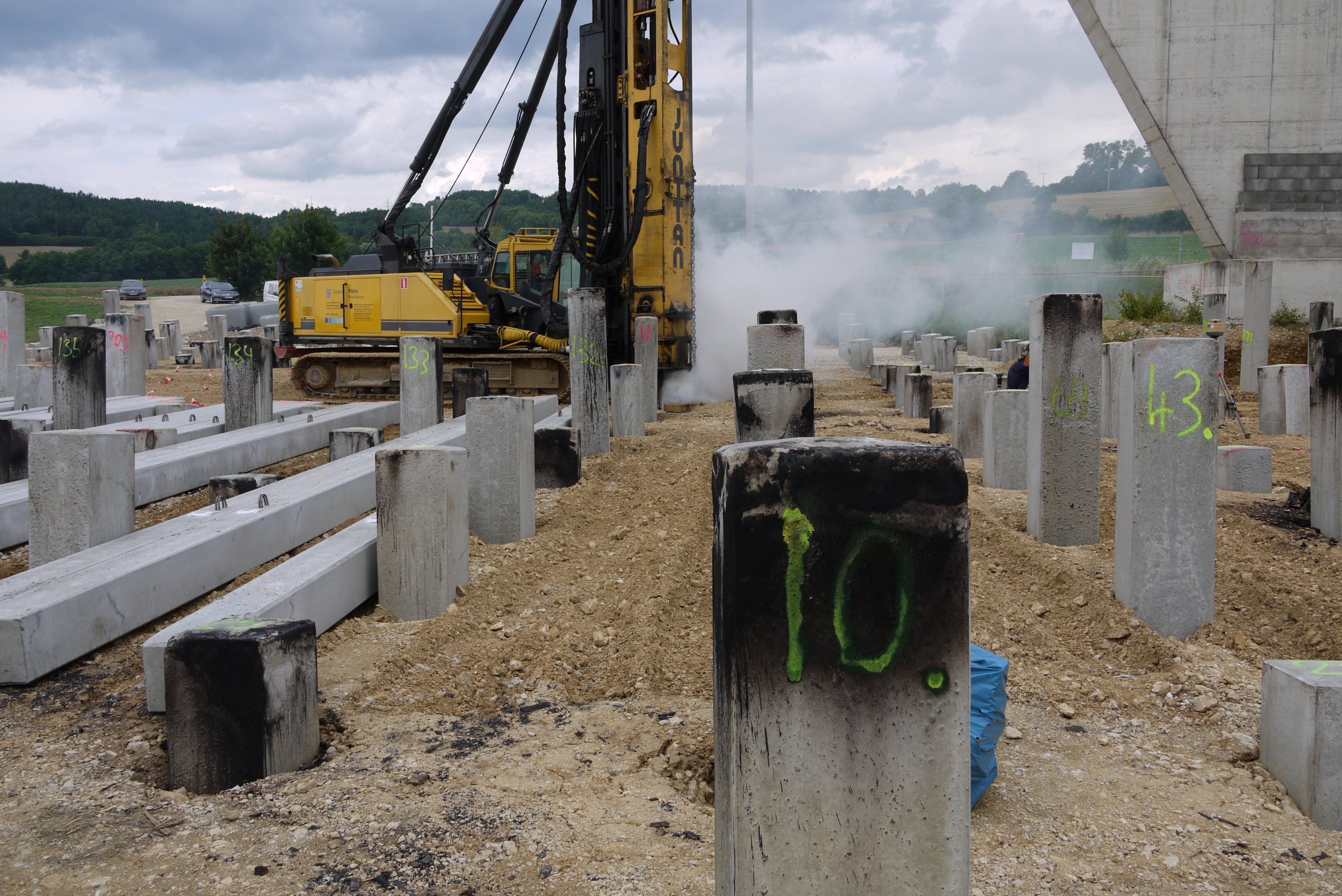
The Technical University of Munich examined 20 different foundation methods and ultimately recommended founding the embankments on precast concrete driven piles with a geogrid-reinforced foundation pad. With this foundation method, the loads from the bridge approaches are transferred via the geogrid-reinforced foundation pad into the piles, which transfer the forces to the deeper, load-bearing red sandstone. This enables a settlement-free connection to the bridge structure, and any joints are reduced to a minimum. For the foundation method described, a pile-ready subgrade is first constructed. The approximately 1,700 precast concrete driven piles are then installed. These are cut to a uniform height, and the piles and pile cap plates are connected using concrete. The spaces between the pile caps are then filled with fill material, so that the geogrids, which distribute the forces evenly into the piles, can be laid on the subgrade. After the fill material has been placed, the geogrids are anchored by folding them back and the fill material is compacted.
Advantages
- Virtually no settlement during construction or operation.
- No waiting times for consolidation, as the soft ground is practically unloaded.
- Relatively short construction time.
- The structure can be put into service immediately.
- Reduced transport of materials.
- Suitable for use in water protection areas
- Pre-cut roll lengths
Further information