


Surface sealing at the Galing landfill site
Project information
Construction project
Galing II Landfill SiteCustomer
Nordenhamer Zinkhütte GmbHConstruction
Matthäi Bauunternehmen GmbH & Co. KG, Westerstede; GSE Lining Technology GmbH, HamburgLocation
Nordenham , DEPlaning
IGB Ingenieurgesellschaft mbH, Hamburg / OldenburgConstruction time
2012 to 2018Products used
Project details


Situation
At the Galing landfill site, located in the Wesermarsch district between Jadebusen and the Lower Weser, the Nordenham zinc smelter has been disposing of jarosite – an inorganic residue from zinc electrolysis – for several decades. In accordance with the Landfill Ordinance, the facility constitutes an on-site single-type landfill. Until now, the fine-grained production residue has been deposited in a leachate collection system within base-sealed earthen basins. The deposited waste, consolidated solely under its own weight, is characterised by low strength and exhibits thixotropic behaviour. The 14-hectare section had reached its planned fill height by the end of 2011 and therefore needed to be secured and reclaimed. Due to the constituents of the jarosite, the disposal section is classified as landfill class DK III. At the same time, process changes were implemented at the zinc smelter, resulting in new mechanical properties of the production residue. The waste exhibits a stable form and usable shear strength and can be processed using standard earthworks techniques..
Solution
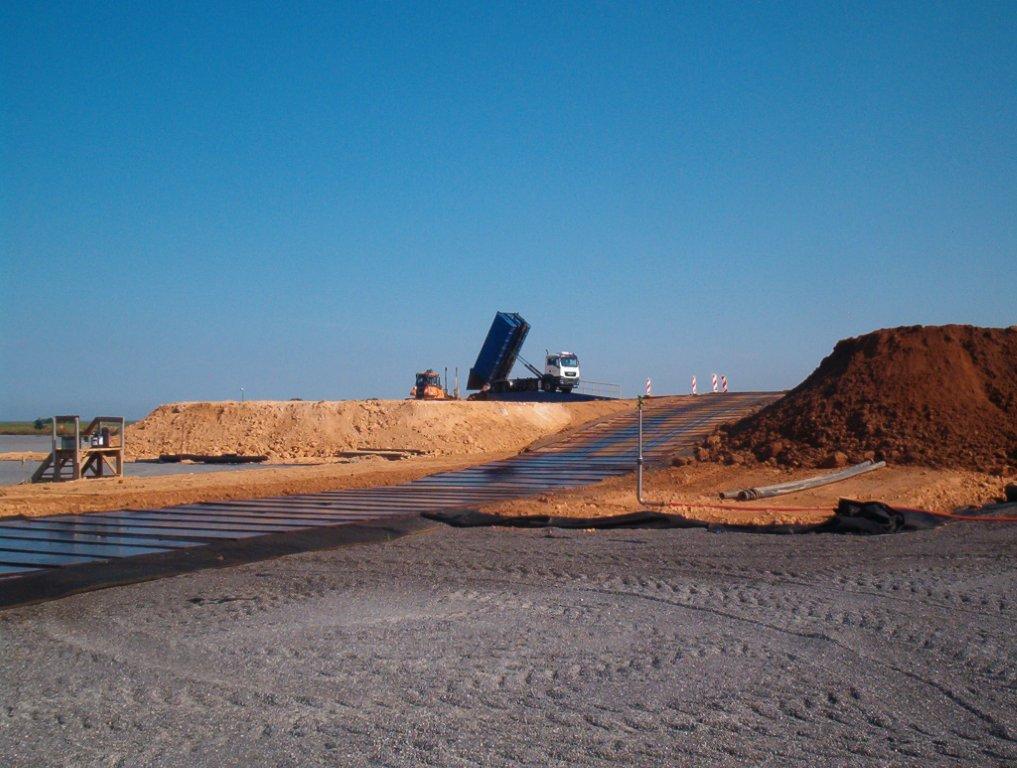
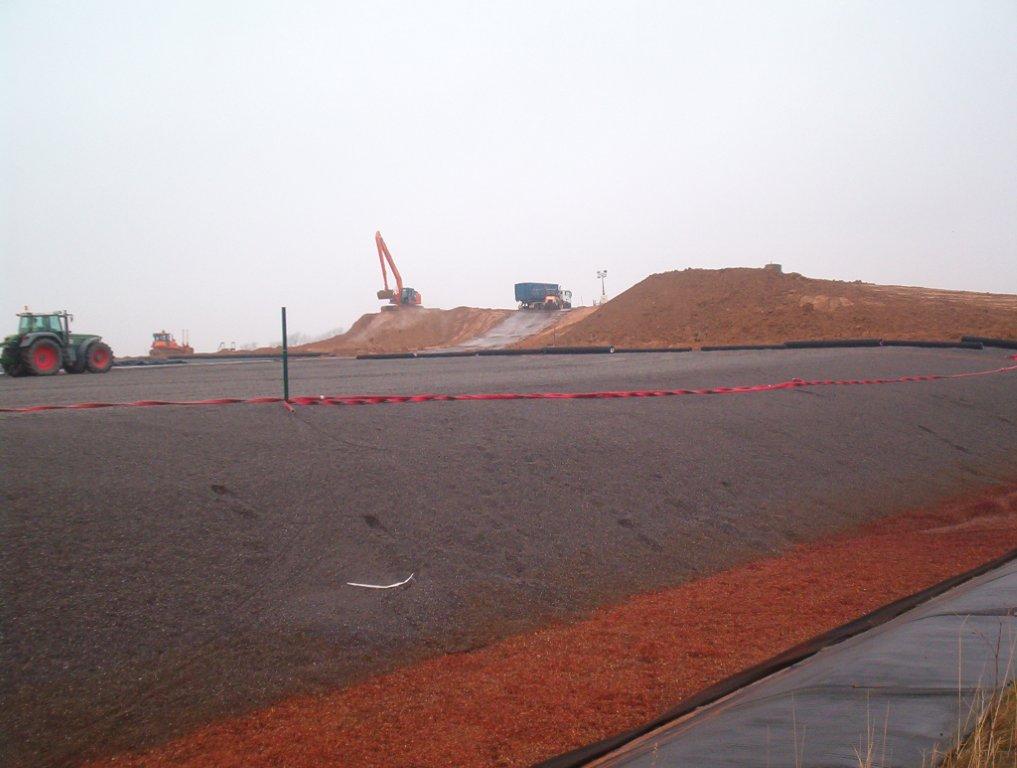
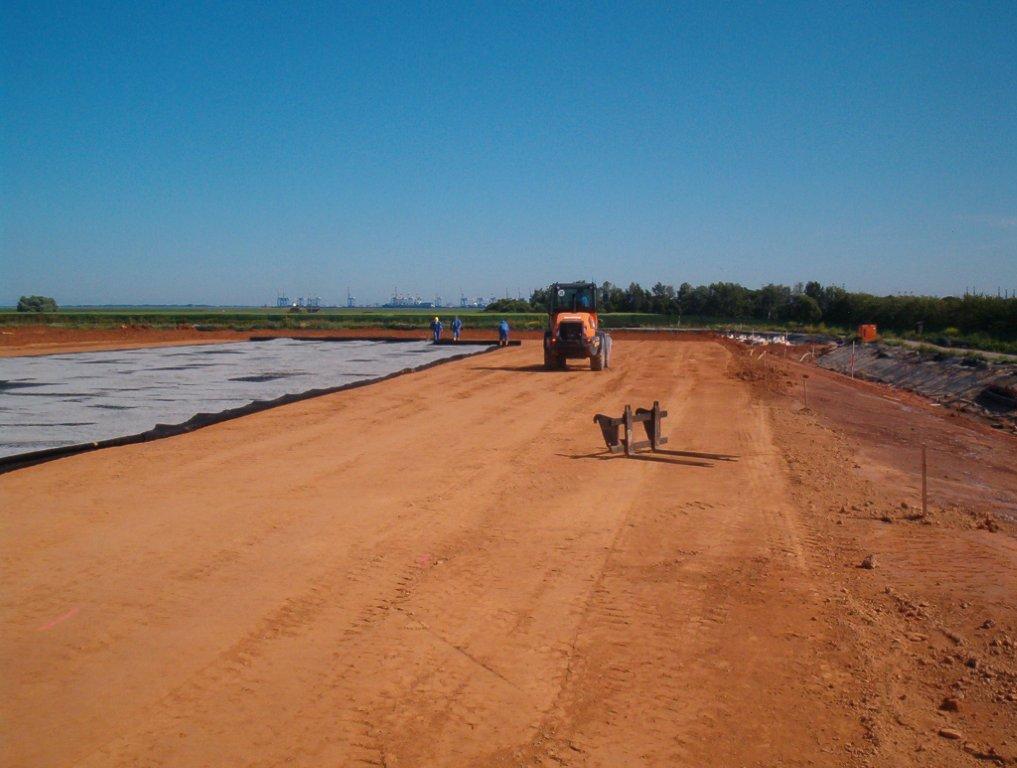
Investigations have shown that a profiled layer of earth materials can be applied onto the existing, low-bearing-capacity and sensitive ‘subgrade’. Prerequisites for this include low load jumps and, due to the thixotropic properties, installation that is essentially vibration-free as well as geosynthetic reinforcement at the interface between the jarosite and the profiled layer. A strip fabric is used here. A controllable surface waterproofing system comprising HDPE plastic waterproofing membrane, geosynthetic clay liner (GCL) and a waterproofing monitoring system represents the optimal solution. The surface waterproofing system, including a plastic drainage element, is installed with a gradient of just 3.5%. Despite this comparatively low gradient and drainage lengths of up to 150 m, it has been demonstrated that the expected rainfall volumes can be safely drained away. At the end of the drainage runs, the plastic drainage element is installed in a double layer. This means that the use of mineral drainage material can be eliminated across all areas.
Advantages
The installation of the GTD offers numerous advantages over a 0.5 m thick mineral sealing layer: conservation of natural soil resources, minimisation of transport requirements and optimisation of landfill volume. Given the size of landfill section II, at around 14 ha, this saved approximately 70,000 m³ of mineral sealing material and created an equivalent amount of additional landfill capacity.
Further information