

Permanente Verkehrsflächen


Wherever the subsoil does not have the required load-bearing capacity and traffic areas have to be used permanently or temporarily, specific measures are required. Differing degrees of subsoil stiffness and varying dynamic and static loads place high demands on the structure of the base course. The aim is to reliably transfer the loads, ensure serviceability and at the same time avoid material loss within the base course.
In practice, the use of geosynthetics in base course reinforcement has proven to be a technically and economically convincing solution. Thanks to their high resistance to mechanical stress, they ensure a significant improvement in load distribution and a significant increase in load-bearing capacity. At the same time, they enable effective separation between the base course material and the subgrade, which prevents mixing of the layers and reduces the required layer thickness. This not only extends the service life and minimizes deformations in the superstructure, but also reduces the formation of rutting and lowers maintenance costs in the long term.
Regardless of whether they are used for temporary construction roads, industrial areas or permanently stressed infrastructure structures, geosynthetics are a solution for high-performance, durable and at the same time economical and ecological traffic surfaces.
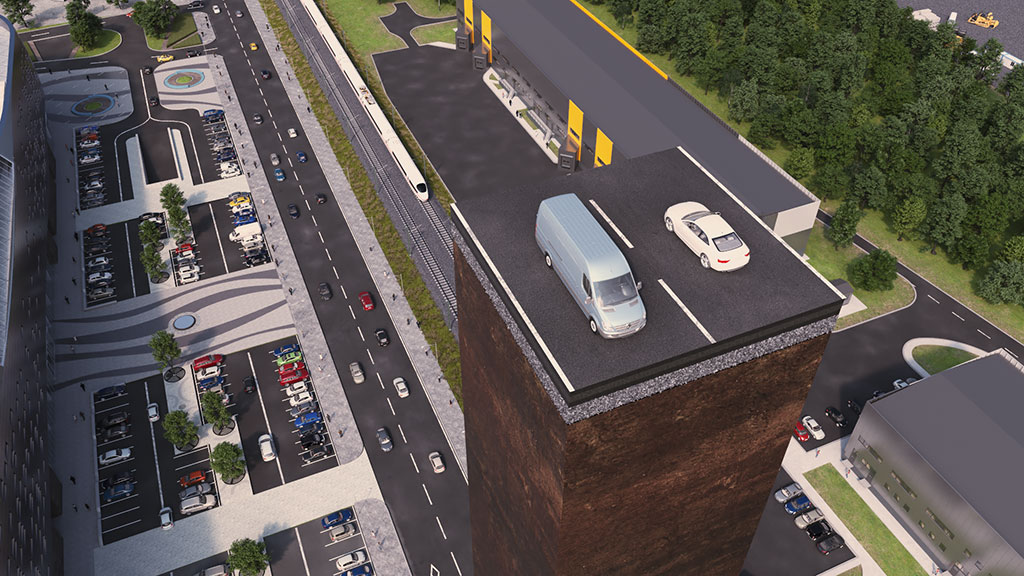
In classified road construction, parking lots or industrial and logistics areas with a bound surface course, the base course is expected to have a high resistance to deformation over a long service life.
Depending on the load-bearing capacity of the substrate, we recommend the following geosynthetic solutions:
HUESKER recommendation
Two-layer base course structure
- If crushed stone, crushed aggregate or coarse gravel is used as the base course material on the subgrade, we recommend composite materials as the first reinforcement layer on the subgrade.
- If sand is used as the base course material on the subgrade, we recommend the use of a PP fabric. The sand is packed into the fabric like a cushion.
- If the base course consists of two layers of ballast, we always recommend a geogrid between the ballast layers (two-layer reinforcement) due to the good interlocking and bonding flexibility.
Please ask our experienced engineers for assistance with the design of your structure.
Product type
HUESKER recommendation
Single-layer base course structure
Due to the low load-bearing capacity of the substrate, we recommend composites or geogrids with a reinforcing effect in these areas of application. Composites are useful if, in addition to the reinforcing function, a separating or filtering function of the geosynthetic is also required, e.g. in cohesive soils. Geogrids are used when only a reinforcing function is required, e.g. for non-cohesive soils.
Product type
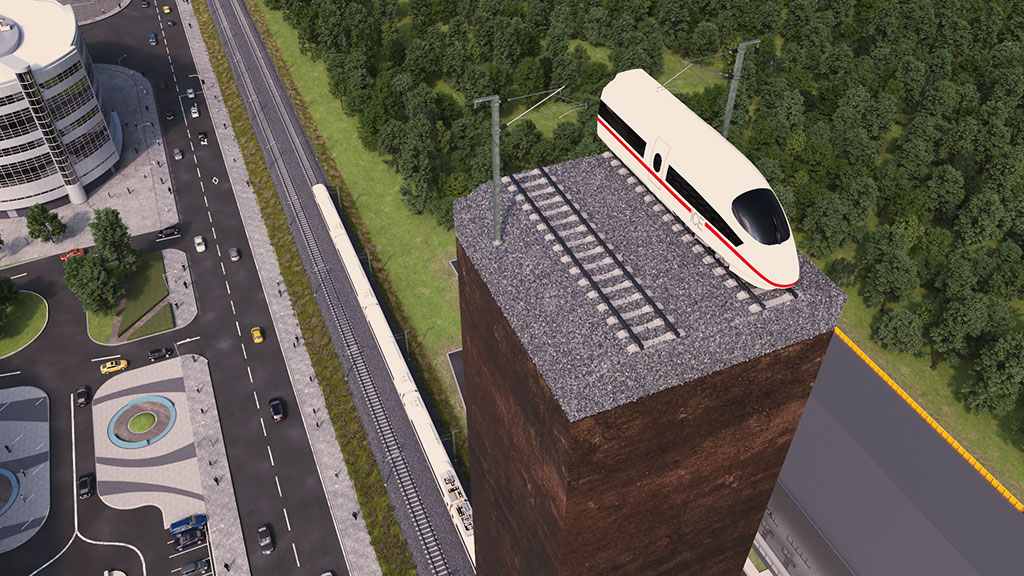
The base layers in railroad construction are subject to specific regulations, regardless of whether it is a new construction or a renovation. High dynamic loads must be absorbed and transferred over a long service life without deforming the track bed.
Depending on the load-bearing capacity of the subsoil, we recommend the following geosynthetic solutions as well as advice from our engineers on the design:
HUESKER recommendation
Two-layer base course structure
- If crushed stone, crushed aggregate or coarse gravel is used as the base course material on the subgrade, we recommend composite materials as the first reinforcement layer on the subgrade.
- If sand is used as the base course material on the subgrade, we recommend the use of a PP fabric. The sand is packed into the fabric like a cushion.
- If the base course consists of two layers of ballast, we always recommend a geogrid between the ballast layers (two-layer reinforcement) due to the good interlocking and bonding flexibility.
Please ask our experienced engineers for assistance with the design of your structure.
Product type
HUESKER recommendation
Single-layer base course structure
Due to the high requirements in these areas of application, we recommend composite materials or geogrids with a reinforcing effect. Composite materials are useful if, in addition to the reinforcing function, a separating or filtering function of the geosynthetic is also required, e.g. for cohesive soils. Geogrids are used when only a reinforcing function is required, e.g. for non-cohesive soils.
Please ask our experienced engineers for assistance with the design of your structure.
Product type
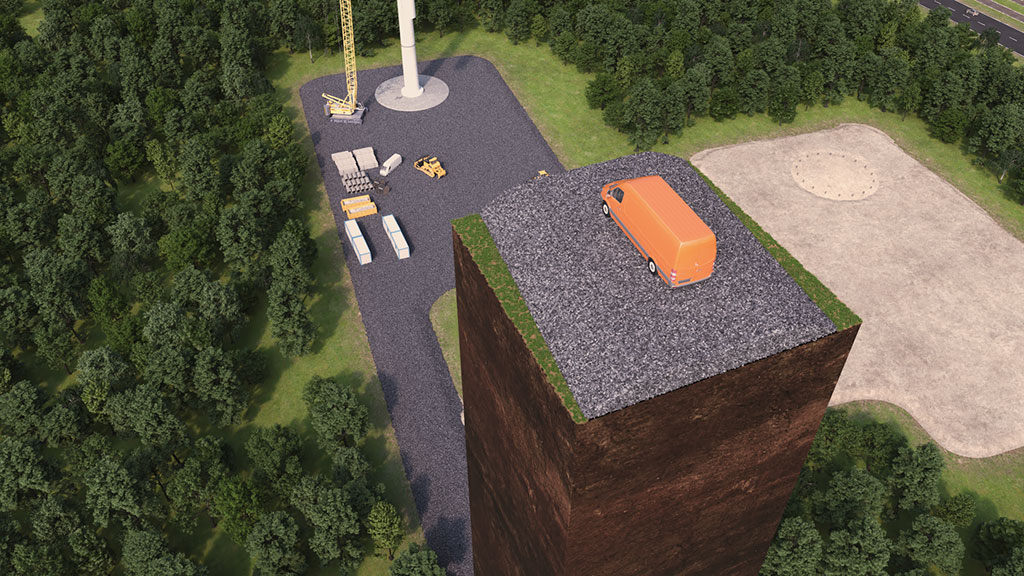
This area of application includes construction roads and access roads in unbound construction. These are either only used intensively on a temporary basis (<2 years) and then removed (construction roads), or used for longer periods and possibly less frequently (e.g. access roads to wind turbines or forestry roads).
HUESKER recommendation
Two-layer base course structure
- If crushed stone, crushed aggregate or coarse gravel is used as the base course material on the subgrade, we recommend composite materials as the first reinforcement layer on the subgrade.
- If sand is used as the base course material on the subgrade, we recommend the use of a PP fabric. The sand is packed into the fabric like a cushion.
- If the base course consists of two layers of ballast, we always recommend a geogrid between the ballast layers (two-layer reinforcement) due to the good interlocking and bonding flexibility.
Please ask our experienced engineers for assistance with the design of your structure.
Product type
HUESKER recommendation
Single-layer base course structure
Due to the low load-bearing capacity of the substrate, we recommend composites or geogrids with a reinforcing effect in these areas of application
Composites are useful if, in addition to the reinforcing function, a separating or filtering function of the geosynthetic is also required, e.g. in cohesive soils. Geogrids are used when only a reinforcing function is required, e.g. for non-cohesive soils.
Product type
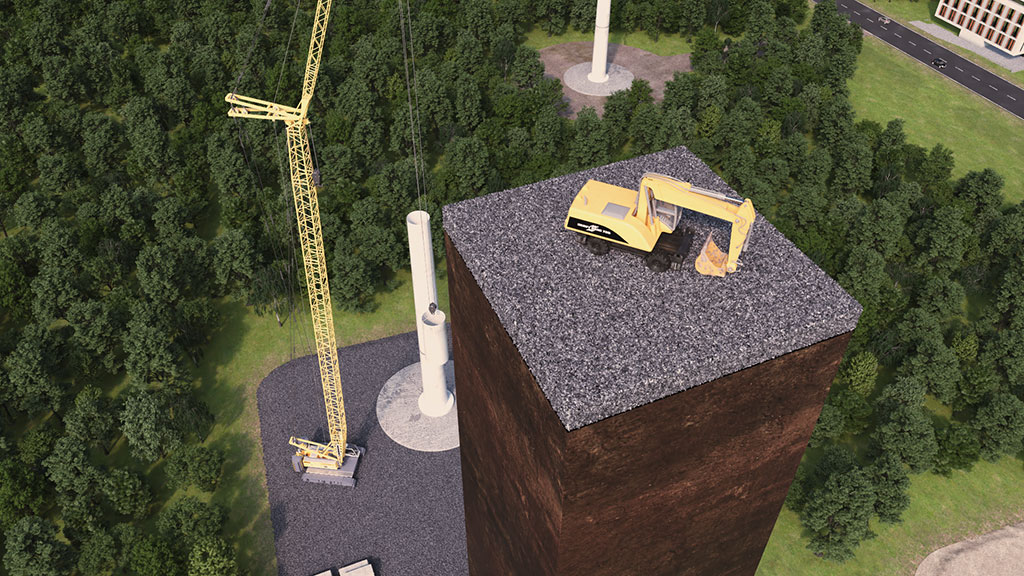
Foundation levels and crane platforms in particular, e.g. for wind turbines, often have to bear abruptly high loads. The platform must be sufficiently dimensioned to ensure that no failure or unacceptable deformation occurs under high loads.
Depending on the load-bearing capacity of the subsoil, we recommend the following geosynthetic solutions as well as advice from our engineers on dimensioning.
Before dimensioning crane footprints, it is also strongly recommended that you contact HUESKER Synthetic GmbH's application technology department, as special verifications are required for this.
HUESKER recommendation
Two-layer base course structure
- If crushed stone, crushed aggregate or coarse gravel is used as the base course material on the subgrade, we recommend composite materials as the first reinforcement layer on the subgrade.
- If sand is used as the base course material on the subgrade, we recommend the use of a PP fabric. The sand is packed into the fabric like a cushion.
- If the base course consists of two layers of ballast, we always recommend a geogrid between the ballast layers (two-layer reinforcement) due to the good interlocking and bonding flexibility.
Please ask our experienced engineers for assistance with the design of your structure.
Product type
HUESKER recommendation
Single-layer base course structure
Due to the high requirements in these areas of application, we recommend composite materials or geogrids with a reinforcing effect.
Composites are useful when a separating or filtering function of the geosynthetic is required in addition to the reinforcing function, e.g. in cohesive soils. Geogrids are used when only a reinforcing function is required, e.g. for non-cohesive soils.
Please ask our experienced engineers for assistance with the design of your structure.
Product type

When constructing cable routes, wind farms or temporary access roads, trafficability and soil protection must be guaranteed. Deep ruts not only impair construction site traffic, but also damage sensitive areas. The Basetrac Plate is a modern load distribution plate that combines high load-bearing capacity with low dead weight, can be laid quickly and can be removed without leaving any residue.


As soon as you click on the link or the preview image, you leave our site and are redirected to www.youtube.com. When you visit this platform, the provider processes your data. You can find more information on this in the YouTube or Google privacy policy.
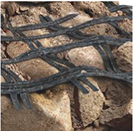
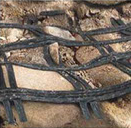
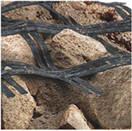
The purpose of a geogrid is to improve the mechanical properties of soils. In order to absorb forces with little deformation, the geogrid requires a certain degree of tensile stiffness. However, the grid must not be too rigid, otherwise it will hinder the soil in absorbing its own forces. Certain tensile strengths are required to compensate for force deficits in the structure. Basetrac geogrids are not only characterized by good tensile strength and rigidity, but also by very high composite flexibility - a property that only flexible geosynthetics possess.
Good composite flexibility means a perfect interplay of macro, meso and micro interlocking as well as a high degree of adaptability to the ground. This significantly improves the bond behavior and the interaction between soil and reinforcement.
(Lackner, C. [2012], Prestressed reinforced soil - Concept, investigations and recommendations, Dissertation, Graz University of Technology)

The BaseCalculator software available online guides you easily to the recommended HUESKER solution. With just a few clicks, you receive suggestions for selecting the right geosynthetic and information on how to save base course material. HUESKER offers you this service simply and easily, i.e. free of charge and without time-consuming registration.